Xi'an, Shaanxi, China · OEM / ODM Transformer & Power Supply Manufacturer [email protected]  |  ✔ Intertek-Verified Supplier
Direct Industrial Manufacturing • Intertek Verified

China Top High Voltage Power Supply Factories & Suppliers

Precision-wound magnetics, high-dielectric SMPS units, and customized industrial power topologies engineered for high-reliability electronic assemblies worldwide.

4.8 / 5.0
Verified Buyer Score
25+
Precision Testing Stations
100%
Full-Load Burn-In & Aging
IEC & CE
Compliance Ready Layouts
Engineered Portfolio

Featured High Voltage & Regulated Power Modules

Engineered for low electromagnetic noise, exceptional galvanic isolation, and maximum thermal headroom across industrial automation, telecommunications, and high-efficiency lighting arrays.
Intertek On-Site Inspected & Verified Manufacturer

Shaanxi Zelqo Power: Engineering-Driven Magnetics & Power Systems

Headquartered in Xi'an, Shaanxi, Zelqo Power operates comprehensive manufacturing, R&D winding stations, and dielectric testing labs dedicated to high frequency transformers, toroidal transformers, low frequency laminated units, and industrial switching power supplies (SMPS).

Unlike conventional contract assemblers that simply solder ready-made modules, our technical engineering team calculates core loss saturation curves, primary/secondary leakage inductance, parasitic capacitance, and thermal dissipation paths specifically adjusted to client operational schematics.
  • Multi-Stage Testing Pipeline: In-process digital bridge LCR analysis, DC resistance verification, impulse winding tests, and dielectric hi-pot safety testing.
  • 100% Thermal Burn-In Inspection: Every batch undergoes full-load elevated temperature aging cycles to eliminate infant mortality rates before dispatch.
  • Full BOM Flexibility: Customization of winding turns, flyback bobbin shapes, copper foil electrostatic shields, potting compounds, and connector terminations.
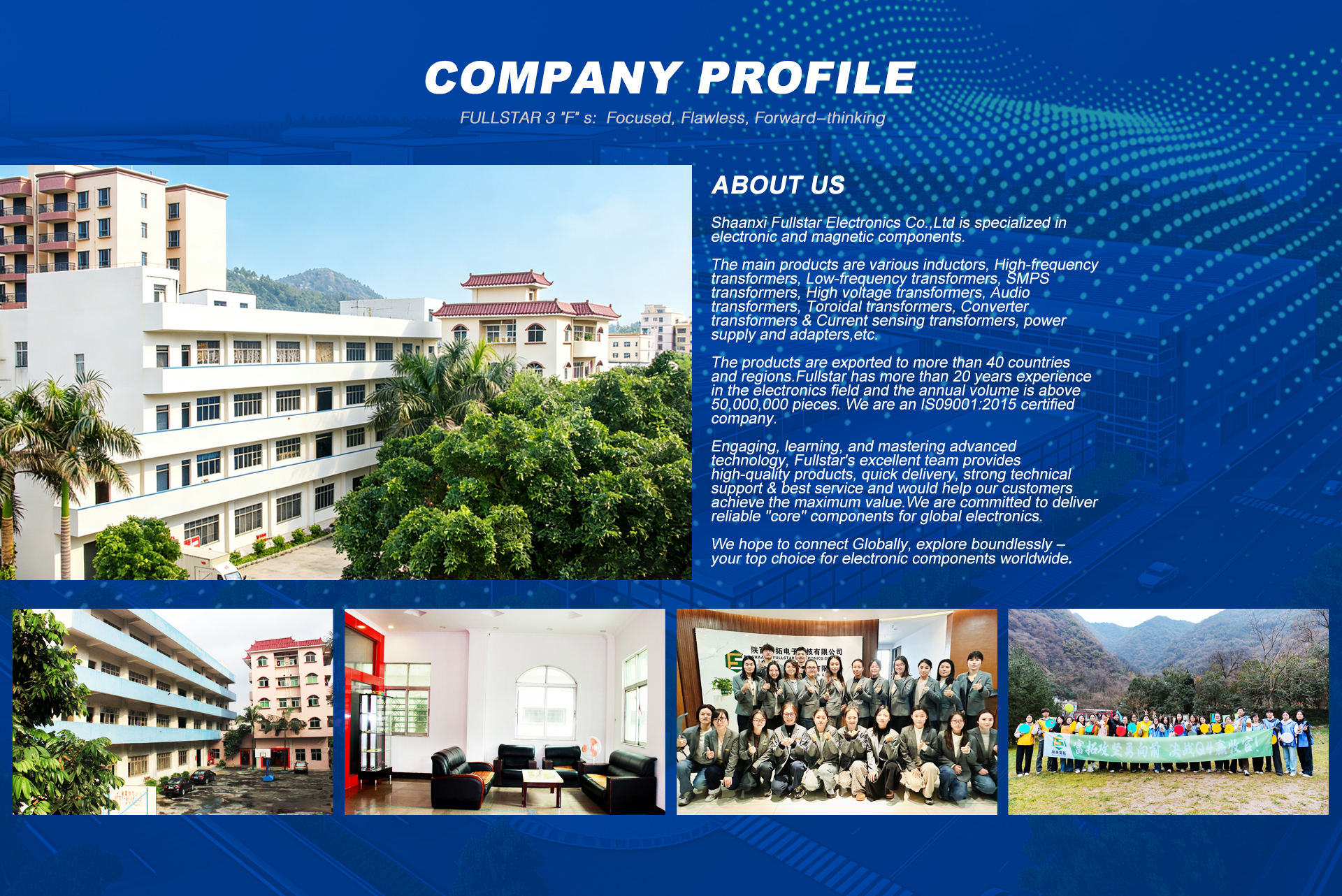
Shaanxi Zelqo Power Manufacturing Facility and Quality Labs
Quality Assurance Protocol

End-to-End High Voltage Quality Control & Traceability

Every industrial power supply and precision transformer undergoes strict electrical validation to meet international safety and insulation thresholds.

STAGE 01

Material Inbound QC

Strict permeability profiling for ferrite cores (Mn-Zn/Ni-Zn), breakdown voltage testing for magnet wire, and bobbin flame-retardant rating checks.

STAGE 02

Automated CNC Winding

Multi-axis computerized tension-controlled winding preserves insulation coating integrity, ensuring repeatable inter-winding capacitance values.

STAGE 03

Inter-Turn Impulse Test

High-voltage impulse wave testing diagnoses microscopic dielectric flaws, corona discharges, or insulation layer weakness across turns.

STAGE 04

Dielectric Hi-Pot Check

Primary-to-secondary dielectric strength breakdown testing (up to 3.75kVAC - 5kVAC) ensuring certified safety isolation against surge transients.

STAGE 05

Burn-In & Load Aging

Dynamic full-load thermal chamber aging monitoring voltage stabilization, ripple rejection, and overall power efficiency before vacuum export packaging.

Procurement Intelligence

Future Procurement Trends in High Voltage & Industrial SMPS

Global procurement teams are shifting priorities from low unit acquisition costs to total lifetime cost of ownership, modular safety architectures, and supply chain verification.

Wide Bandgap Semiconductor Integration

The transition toward Gallium Nitride (GaN) and Silicon Carbide (SiC) MOSFET topologies is compelling high voltage suppliers to produce magnetic components capable of operating at frequencies exceeding 200kHz to 1MHz.

Procurement directors must prioritize suppliers possessing multi-strand Litz-wire winding capabilities and specialized planar magnetic tooling to mitigate severe high-frequency skin and proximity losses.

Direct-to-Factory Engineering Collaboration

Off-the-shelf catalog supplies frequently leave systems vulnerable to harmonic heating, excess ripple, and EMC failures. The industry is rapidly pivoting toward agile ODM/OEM development cycles.

Procuring custom transformers wound to exact turns ratios directly reduces secondary stage regulator losses, saving board space, shrinking chassis volume, and accelerating field deployment validation.

Verified Environmental & Thermal Resilience

Modern applications in industrial robotics, outdoor telecommunications, and electric mobility infrastructure require extended operating temperature profiles (-40°C to +85°C).

Buyers are mandating automated vacuum pressure impregnation (VPI) varnishing, silicon elastomer encapsulations, and certified resistance to salt-fog, humidity, and operational mechanical shock.

Architectural Evolution

Key Design Trends Shaping Next-Gen Power Supplies

Analysis of upcoming standards, component integration, and mechanical engineering directions across industrial topologies.

High Volumetric Power Density

Demands for compact DIN-rail and embedded rack enclosures have forced manufacturers to shrink footprints by 35%. This is achieved through resonant LLC half-bridge layouts, synchronized rectification, and custom-molded high-permeability PQ and RM core packages that offer optimum core-to-winding volume ratios.

Electromagnetic Compatibility (EMC) Compliance

Conducted and radiated emissions remain a leading barrier during laboratory homologation (CISPR 32 / EN 55032 Class B). Modern SMPS architectures embed integrated multi-stage common mode chokes, inter-winding copper shielding foils, and balanced split-winding geometries to suppress differential noise at the source.

Intelligent Digital Monitoring

Next-generation high-voltage DC supplies are moving beyond static analog potentiometers to integrate I2C, PMBus, and RS485 communication protocols. Real-time logging of internal thermal sensors, dynamic current draw, and ripple monitoring allows industrial systems to predict component wear and execute predictive maintenance.

Technical Support

High Voltage Power Supply Procurement FAQ

Authoritative technical answers to assist sourcing managers and electronics engineers during supplier qualification and BOM finalization.

What engineering variables must be specified for custom high-voltage transformers?
To generate an optimized calculation model, our engineering department requires: input nominal voltage and tolerance frequency; primary-to-secondary output voltage ratios; continuous and peak current load limits; switching topology (Flyback, Forward, Half-Bridge LLC, Push-Pull); planned operating frequency; target isolation test limits (e.g., 3000VAC - 4000VAC hi-pot test); creepage and clearance distances; thermal limits (Insulation Class B, F, or H); and mechanical dimensional boundaries including lead-out styles or PCB pinout pitch.
How do China top factories solve thermal dissipation in enclosed power supplies?
Thermal control relies on a triple strategy: 1) Core material selection minimizing hysteresis losses at elevated frequencies; 2) Thermal gap-filler pads coupled with extruded aluminum heat sinks positioned directly adjacent to switching MOSFETs and secondary Schottky rectifiers; 3) Perforated aluminum chassis design engineered for natural convection chimneys or temperature-triggered brushless DC cooling fans for outputs above 300W.
What is the difference between Toroidal and Laminated EI transformers in high voltage setups?
Toroidal transformers feature a continuous ring core made from grain-oriented silicon steel without air gaps. This produces extremely low stray magnetic fields (low audio hum and low EMI), superior electrical efficiency, and a compact cylindrical footprint ideal for medical devices and audio amplification. Laminated EI transformers are heavier and exhibit higher magnetic leakage, yet provide exceptional cost efficiency, robust physical durability, and high tolerance to input line transients in utility control panels.
How does Zelqo Power guarantee batch-to-batch dielectric safety isolation?
Every production batch undergoes automated hi-pot testing between primary, secondary, and ground connections using calibrated hipot analyzers. Furthermore, high voltage transformers leverage triple-insulated winding wire (TIW), margin barrier tape, and vacuum-sealed polyester or epoxy encapsulation. This ensures full compliance with IEC 61558, IEC 60601-1 (medical isolation standards), and IEC 62368-1 multimedia requirements.
What is the typical prototype lead time and MOQ for custom OEM configurations?
Standard transformer and SMPS engineering samples are typically completed within 5 to 9 business days following electrical schematic approval. Initial prototype evaluation batches have flexible minimum quantities to assist client laboratory validation and pilot testing. Mass production lead times typically range from 2 to 3.5 weeks depending on copper and core inventory availability.

Collaborate Directly with Transformer & Power Specialists

Bypass intermediaries and access direct-from-factory engineering support. Submit your electrical schematic, voltage requirements, and enclosure envelope to receive a verified custom quote and comprehensive DFM design review within 24 hours.

Send an Inquiry